
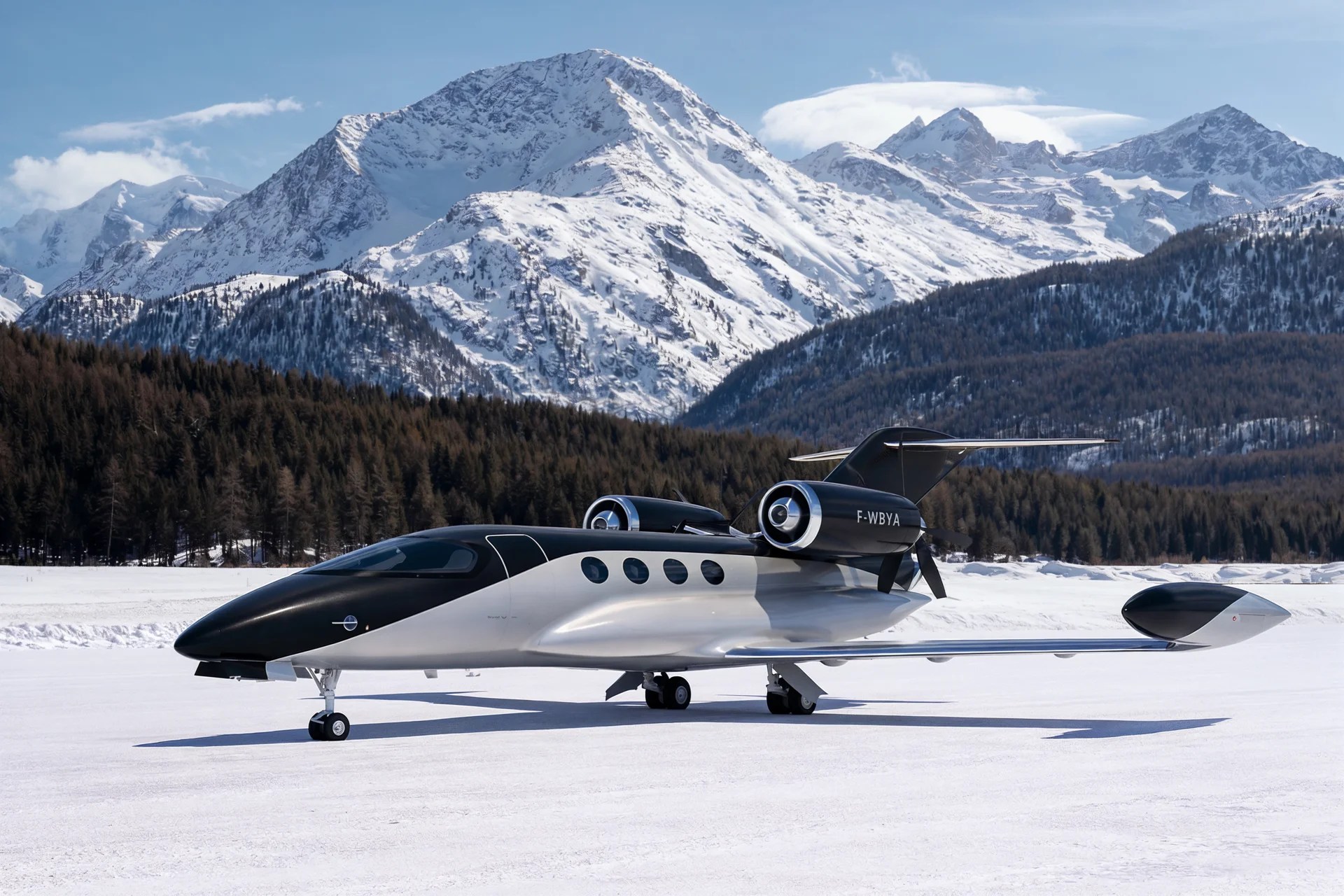
The Nordic Region Is Building the Runway to Zero-Emission Flight
For decades, aviation’s environmental footprint has been measured almost exclusively in one currency: carbon. Released CO2 lingers in the atmosphere with an undesirable impact. Today, two parallel technologies are rewriting that equation, sustainable aviation fuel (SAF) as the bridge, and green hydrogen as the destination. Nowhere is that shift more visible, or more ambitious, than in the Nordic region, where Denmark, Norway, Sweden, and Finland are positioning themselves as the proving ground for the next era of flight.
At Huginn Aviation, we sit at the intersection of this transition, not only as official sales representatives for Daher, manufacturer of the TBM 980, Kodiak 100, and Kodiak 900, but also as the official Nordic Area Sales Representative for Beyond Aero, developer of the BYA-1, the world’s first hydrogen-electric business aircraft. We are also proud members of NISA, the Nordic Initiative for Sustainable Aviation, the cross-industry organization working to advance SAF, electric, and hydrogen propulsion across the Nordic region. Understanding SAF and green hydrogen is understanding where our industry is headed, and why the Nordics are already leading the way there.
Sustainable Aviation Fuel: The Bridge We’re Crossing Now
Sustainable aviation fuel is a “drop-in” replacement for conventional jet fuel — chemically similar enough to be blended directly into existing aircraft, engines, and airport fueling infrastructure, but produced from renewable feedstocks rather than crude oil. Used cooking oil, agricultural and forestry residues, municipal waste, and, increasingly, synthetic pathways that combine captured CO2 with green hydrogen, all serve as building blocks for SAF.
The climate case is compelling. Measured across its full life cycle, SAF can cut CO2 emissions by up to 80% compared with conventional jet fuel, with some pathways aiming even higher as the technology matures. Because the industry currently permits blending of up to 50% SAF with fossil kerosene, airlines and operators can start reducing their footprint today, without waiting for new aircraft.
Major fuel suppliers are scaling accordingly. Shell has committed to producing around 2 million tonnes of SAF annually and has already begun phasing out crude-based jet fuel production at some of its European refineries as part of a broader push toward net-zero operations. BP, through its aviation arm air bp, is expanding SAF production and feedstock diversity globally, and has highlighted the opportunity for Europe to grow local feedstock supply, noting that cover crops planted on just 10% of the EU’s arable land could supply roughly 5 million tonnes of SAF a year, nearly meeting the bloc’s 2030 target on its own. Air bp is also investing in “eSAF”, that is synthetic fuel made from captured carbon and hydrogen produced via electrolysis, a pathway expected to scale through the 2030s as renewable electricity and green hydrogen become more abundant and affordable.
SAF, in short, is the fastest way for aviation to cut carbon right now. But it is not the finish line. It still involves combustion, still produces CO2 at the point of use, and remains dependent on limited feedstocks. That is where hydrogen-electric propulsion enters the picture.
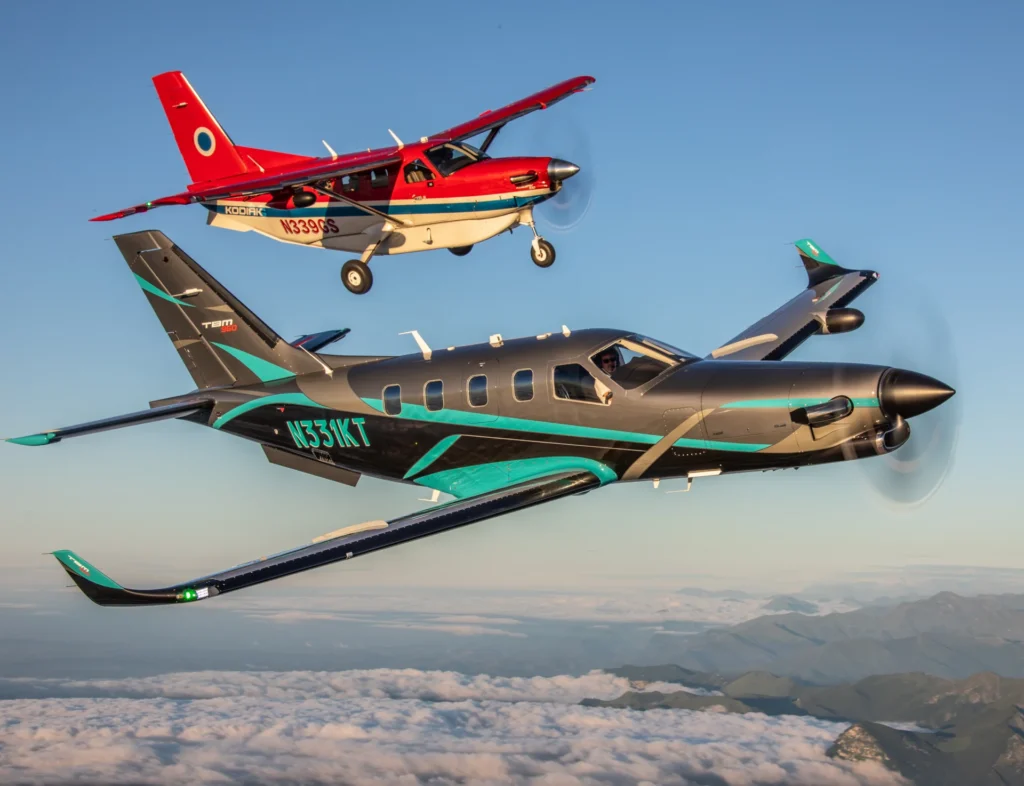
This is also why SAF matters directly to the aircraft Huginn Aviation sells today. As official sales representatives for Daher, we represent the TBM 980, Kodiak 100, and Kodiak 900, all of which are approved to fly on SAF. Owners and operators of these aircraft don’t need to wait for a new generation of propulsion to start reducing their emissions; every one of these Daher turboprops can already be fuelled with SAF at any airport that supplies it, cutting lifecycle CO2 substantially with no modification to the aircraft. It’s a meaningful first step available right now, and many of our clients across the Nordic region increasingly ask about.
Green Hydrogen and Zero-Emission Flight
Green hydrogen is produced by using renewable electricity, wind, hydropower, or solar, to split water into hydrogen and oxygen through electrolysis. No fossil inputs, no combustion-related CO2. When that hydrogen is used to power a fuel cell aboard an aircraft, as in Beyond Aero’s BYA-1, the only byproduct of flight is water vapor. There is no CO2 released at all, not “reduced,” not “offset” it is simply eliminated at the source.
This is the leap the BYA-1 represents. Beyond Aero’s clean-sheet, hydrogen-electric light jet stores gaseous hydrogen at 700 bar in wing-integrated tanks and feeds it through a fuel cell system rated at 2.4 MW to power twin electric engines. The result is an aircraft designed to carry 6–8 passengers over 800 nautical miles at speeds up to 360 knots, comfortably covering more than 80% of European business aviation routes, while refueling in around 30 minutes and requiring less than 800 meters of runway. With roughly 90% fewer moving parts than a turbine power train, it also promises lower maintenance costs alongside its zero-emission profile. Early projections suggest hydrogen fuel could undercut the cost of Power-to-Liquid (PtL) SAF by around 65% and even beat conventional Jet A-1 pricing within the coming years, as hydrogen infrastructure matures.
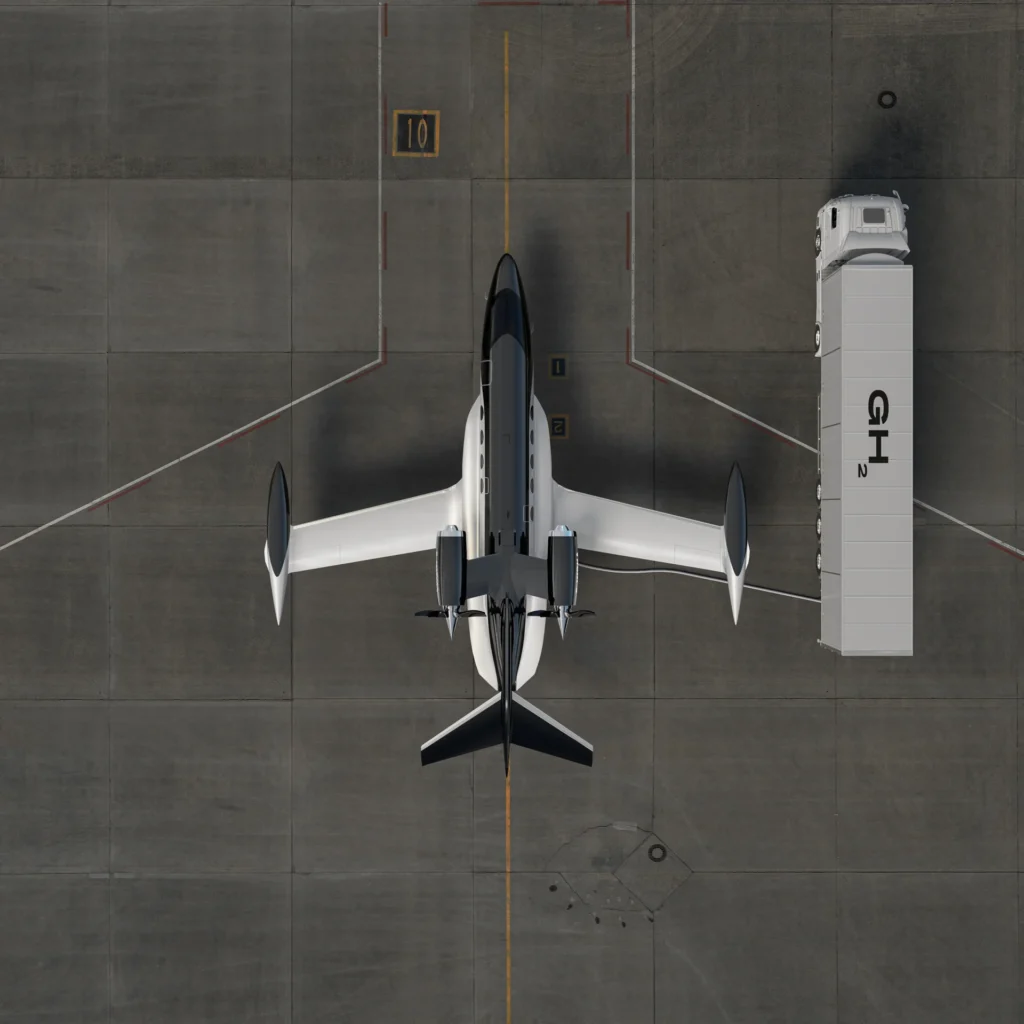
Beyond Aero has already flown a hydrogen-electric demonstrator, France’s first manned flight of its kind and is working directly with EASA to help write the certification standards for hydrogen-electric propulsion, since none currently exist for this class of aircraft. Certification is targeted for the end of the decade, with the BYA-1 positioned to be among the very first hydrogen-powered business jets to reach the market.
The Nordic Region: A Frontier for Hydrogen
Few regions in the world are better positioned to fuel this transition than Scandinavia and Finland. Abundant hydropower, wind, and low electricity prices give the Nordics some of the most competitive green hydrogen production costs in Europe with forecasts pointing toward €4 to €7 per kilogram in Sweden and Denmark, and €4 to €6 per kilogram in Norway, by 2030.
The projects already underway illustrate how far along the region is:
- Denmark hosts one of Europe’s first operational green hydrogen plants, a 12 MW facility at Måde, alongside e-methanol production at Kassø and e-methane at Glansager. Denmark has also committed to a full transition to sustainable aviation fuel by 2030, backed by a dedicated national support scheme.
- Finland operates an industrial-scale 20 MW green hydrogen plant at Harjavalta, and the Finnish “Cloudberry” project, a planned 500 MW electrolyser led by Vetyalfa Oy, was recently selected for EU funding as one of the most cost-competitive hydrogen projects on the continent, with a projected output exceeding 500,000 tonnes of hydrogen over a decade.
- Norway combines low-cost hydropower with growing offshore wind capacity, and two Norwegian projects, Gen2-LH2 and RogalandH2, were selected under the EU’s dedicated Maritime-Aviation funding category specifically to build out hydrogen supply for hard-to-abate transport sectors, aviation being among them.
- Sweden is home to active hydrogen-aviation infrastructure work, including partnerships exploring hydrogen-powered regional flights at airports such as Skellefteå, alongside a broader Nordic collaboration between airframers, energy companies, and airport operators studying hydrogen refueling needs across dozens of Nordic airports.
Beyond individual projects, the five Nordic transport ministers (Denmark, Norway, Sweden, Finland, and Iceland) have jointly committed to establishing the world’s first fossil-free regional air routes by 2030, a political signal matched by real investment in the hydrogen value chain, from the Nordic Hydrogen Valleys programme to a wave of EU-backed electrolyser projects across the region.
Standing With the Nordic Sustainable Aviation Community
This kind of regional progress doesn’t happen through any single company or project, it happens through industry-wide cooperation. That is why Huginn Aviation is a proud member of NISA, the Nordic Initiative for Sustainable Aviation, an independent, cross-cutting organization working on behalf of Nordic airlines, airports, industry bodies, aircraft producers, and technology developers to promote and accelerate sustainable aviation across the region.
NISA’s work spans the full spectrum of the transition outlined above, from scaling the use of SAF in today’s fleet, to supporting electrofuels produced from renewable energy and captured carbon, to preparing airport infrastructure for the electric and hydrogen-powered aircraft of tomorrow. The organization is also a partner in ALIGHT, a five-year EU Horizon 2020 project focused on integrating SAF into European airports and developing sustainable ground energy infrastructure, where NISA leads the work package dedicated to sustainable fuel agreements and airport readiness for future propulsion technologies.
Being part of NISA means Huginn Aviation isn’t just selling the aircraft of the future, we’re actively engaged in the Nordic ecosystem, from fuel to infrastructure to airspace, that will let that future actually fly.
Why This Matters for Nordic Operators and Owners Today
SAF and green hydrogen are not competing technologies, they are sequential steps on the same runway. SAF allows the aviation industry to cut emissions within today’s aircraft fleets, while green hydrogen, paired with aircraft purpose-built for it, like the BYA-1, opens the door to true zero-emission flight. The Nordic region’s investment in renewable electricity, electrolyser capacity, and hydrogen infrastructure means that by the time the BYA-1 reaches certification, the fuel to power it at scale will increasingly be produced right here, close to home.
For operators and forward-looking owners across Denmark, Norway, Sweden, and Finland, this is a rare moment: the chance to engage early with an aircraft program that isn’t simply reducing aviation’s carbon footprint, but eliminating it, in a region already building the infrastructure to support it.
Huginn Aviation is proud to serve as Daher’s official sales representative for the TBM 980, Kodiak 100, and Kodiak 900, and as Beyond Aero’s official Area Sales Representative across the Nordic region. Whether you want to start reducing emissions today with a SAF-ready Daher turboprop, or learn more about the zero-emission BYA-1 and what it means to be part of this transition early, we would welcome the conversation.